Bharatanatyam
Bharata Natyam is one of the oldest dance forms of India. It was nurtured in the temples and courts of southern India since ancient times. Later it was codified and documented as a performing art in the 19th century by four brothers known as the Tanjore Quartet whose musical compositions for dance form the bulk of the Bharata Natyam repertoire even today. The art was handed down as a living tradition from generation to generation under the Devadasi system under which women were dedicated to temples to serve the deity as dancers and musicians forming part of the elaborate rituals. These highly talented artists and the male gurus (nattuvanars) were the sole repository of the art until the early 20th century when a renewal of interest in India’s cultural heritage prompted the educated elite to discover its beauty.
Brahma created the fifth Veda, which is a combination of the existing four vedas [Rig, Yajur, Sama, and Atharva Veda]. He propagated this veda on earth through Sage Bharatha, who wrote it down as Natyashastra. Brahma took words from the Rig veda, Abhinaya [communicative elements of the body movements] from the Yajur Veda, Geeth [music and chant] from the Sama
Veda, and Rasa [vital sentiment, an emotional element] from Atharva veda, to form the fifth veda – the Natya Veda. Bharatha, together with groups of Gandharvas and Apsaras performed
Natya, Nritta, and Nritya before Lord Shiva [the Lord of Divine Dance]. Thus Natya became the authoritative form of classical Indian dances. The term “Bharatnatyam” partly owes its name to
Sage Bharathamuni bharatanatyam often is used to express Hindu religious stories and devotion.
Bharatnatyam is more than a graceful art form – it requires skill, precision, strength, and discipline.
There are various styles of Bharatnatyam. The one that will be performed today is Vazhuvoor style. The style is known for its grace, fluidity, and subtlety.
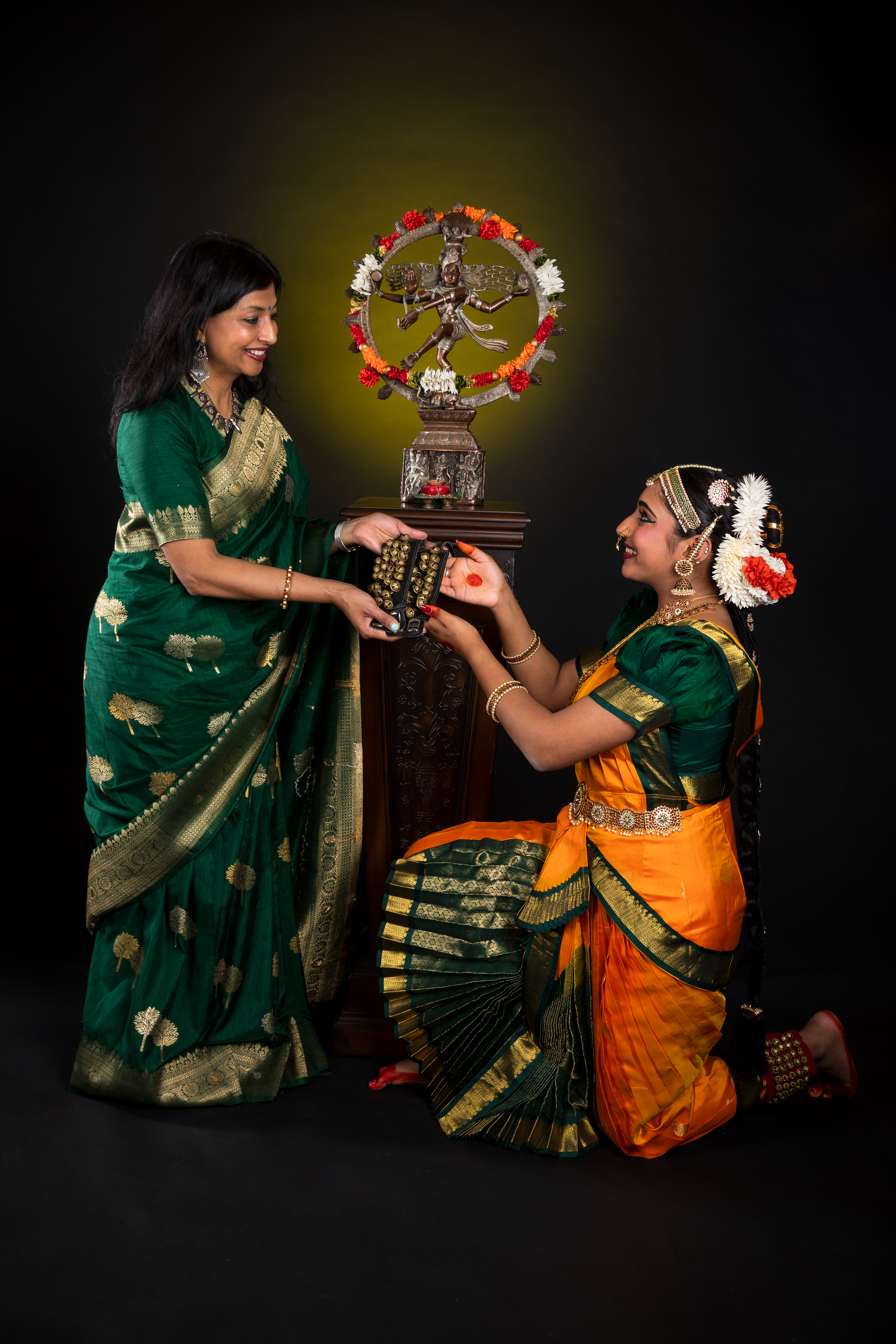
Arangetram is a combination of the Tamil words “arangu” for stage and “etram” for ascent and its literal translation means “ascending on stage”. It marks the formal debut performance of a student who has completed the initial training in the dance form. On this occasion, the Sishya (student) seeks the blessings of the divine dancer, Lord Nataraja and her Guru (teacher) and presents the art form with devotion and sincerity.
Please note a few housekeeping items. Please place your phones on silence or vibrate mode, avoid exiting or entering the hall once the program begins as this can be disruptive to the dancer. If you must step out, please do so between the compositions not during the performance. We request you to refrain from taking flash photography as this can distract the dancer. Please refrain from walking around or talking during the performance as it disrupts the focus of the dancer.
Contact
Balaji Sathyamoorthy Musuwathi
Phone: 614 787 5050
Email: mscbalaji@gmail.com
***
Vaishnavi Dwaragan Morkonda
Phone: 954 779 4595
 Sheshfika.net